
Spanish mackerel trolling rig setups do not have to be complicated, but when you find one that swims properly, runs at a useful speed and catches fish, it is worth paying attention.
This article breaks down a favourite bait-swimming rig for Spanish mackerel.
It is designed mainly for long, skinny baits like garfish and pike. These baits have the right shape to fit neatly into a wog head and kick naturally behind the boat.
The best part is that this Spanish mackerel trolling rig can be trolled faster than many standard dead bait rigs. Instead of only crawling along at idle speed, this setup can swim from idle up to around 5 knots, sometimes a touch more when rigged well.
That makes it very useful when you are travelling between reef patches, searching big areas, or covering ground while still keeping a proper bait in the water.
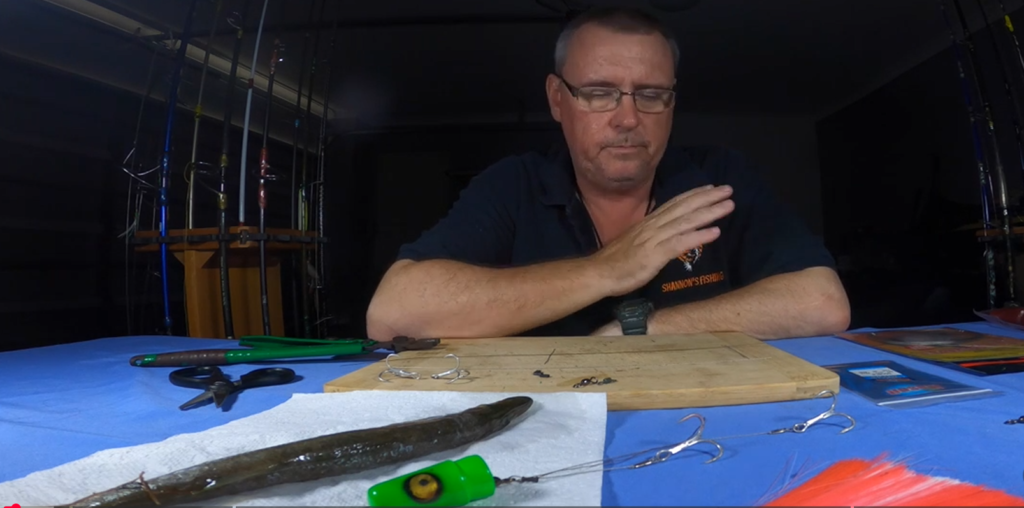
This guide is based on a transcript showing how to build and bait up a favourite Spanish mackerel rig using treble hooks, multi-strand wire, single-strand wire, swivels, copper rigging wire and a wog head.
Before chasing Spanish mackerel, check your local fishing rules. In Queensland, Spanish mackerel rules were updated in 2026, with recreational boat limits increasing to 4 fish per boat when 4 or more people are on board, while the 75cm minimum size and closed seasons still apply.
Why This Spanish Mackerel Trolling Rig Works
A good Spanish mackerel trolling rig needs to swim straight.
That sounds obvious, but it is where many dead bait rigs fail.
If the bait spins, it looks wrong. It twists your line, ruins the presentation and usually gets ignored.
This rig works because the bait is held by the head, not pinned stiffly through the whole body. The treble hooks trail underneath the bait, while the garfish or pike is free to kick and swim.
That gives the bait a more natural action.
The wog head adds weight and shape at the front. It helps the bait track cleanly and gives the front of the rig a neat profile.
Spanish mackerel are fast predators. They love bait that looks wounded, separated and easy to run down.
This rig gives them exactly that.
Gear Needed For This Spanish Mackerel Trolling Rig
To make this Spanish mackerel trolling rig, you need a few simple rigging parts.
You will need good quality treble hooks around size 2.
You will need crimps matched to your wire.
You will need soft multi-strand wire, ideally around 40lb to 60lb. A 49-strand wire is a good choice because it is soft and flexible.
You will also need around 60lb single-strand wire.
Add a couple of small swivels, some copper rigging wire and a wog head.
The wog head is important because the bait’s nose slides into it. This helps the bait swim properly and gives the rig that clean, deadly mackerel profile.
Use quality hooks and wire.
Spanish mackerel have sharp teeth and hit hard. Cheap hooks, bad crimps or poor wire can cost you fish.
See my Mackerel Fishing Gear page for the tackle and lures I recommend for casting and trolling.
Best Baits For A Spanish Mackerel Trolling Rig
This Spanish mackerel trolling rig is made for long, skinny baits.
Garfish are one of the best choices.
Pike are another excellent option.
Both have a long, narrow shape and a pointy nose, which lets them slide neatly into the wog head.
That is why this rig works so well.
It is not really designed for big chunky baits. A bait with a wide head will not sit as cleanly in the wog head, and it may not swim as well.
When you use the right bait, the body kicks behind the boat and the hooks trail underneath.
That kicking action is what gets Spanish mackerel fired up.
If you are travelling between reef areas or working over a big patch of ground, run a couple of these baits out the back and let them swim.
They look natural, they cover water and they catch fish.
How To Build The Hook Section
Start by crimping one treble hook onto the end of the soft multi-strand wire.
Keep a small loop so the hook can swing freely.
Next, slide on another crimp and add a swivel into the loop. Do not crimp it down until you have measured the bait.
Then add the second treble hook onto the tag end and crimp it in place.
Lay the rig beside the garfish or pike you plan to use.
The swivel should sit near the eye of the bait.
One treble should sit around the middle of the body.
The other treble should sit closer to the tail.
Once the spacing looks right, crimp the swivel loop in place.
This hook section is the working end of the Spanish mackerel trolling rig.
The hooks do not need to be stuck into the bait.
They trail underneath it while the bait swims.
That is what makes the rig so simple and effective.
How To Add The Wog Head
Now take your 60lb single-strand wire and haywire twist a swivel onto one end.
Slide the wog head onto the wire the correct way.
Make sure the witch head is facing forward so the skirt, feathers or head shape sits properly when trolling.
Then haywire twist the hook section onto the other end of the single-strand wire.
At this point, the rig is almost finished.
The front has a swivel.
The wog head sits behind it.
The back section has the two trailing trebles.
The final step is adding copper rigging wire to the front swivel area. Tie or twist a short piece of soft copper wire onto the eye of the swivel near the wog head.
This copper wire is what holds the bait’s head in place.
Once you understand the layout, this Spanish mackerel trolling rig is not hard to make.
It just needs to be measured properly for the bait size.
How To Bait This Spanish Mackerel Trolling Rig
To bait this Spanish mackerel trolling rig, start by removing the eyes from the garfish or pike.
This gives you a clean eye socket to pass the copper rigging wire through.
Lay the hooks under the bait so one treble sits midbody and the other sits near the tail.
Now pass the copper wire through the eye socket.
Bring it back through the eye of the swivel.
Then pass it through the bait’s eye socket again.
Repeat this a few times until the bait is held firmly against the swivel.
You are basically tying the bait’s head to the swivel through the eye socket.
Once it is snug, slide the pointy nose of the bait into the wog head.
That is it.
The bait is held at the head, the hooks trail underneath, and the body is free to kick.
Drop it beside the boat before sending it back.
If it swims straight and kicks naturally, it is ready.
How Fast To Troll This Spanish Mackerel Trolling Rig
One big advantage of this Spanish mackerel trolling rig is speed.
Many dead bait rigs need to be slow-trolled carefully.
This one can handle more pace when the bait is rigged correctly.
Idle speed is fine.
Three knots is fine.
Four or five knots can also work.
The transcript mentions this rig swimming up to about 5 to 5.5 knots, with the idea that it can be pushed close to 6 knots when conditions and rigging are right.
That makes it great for covering water.
If you are fishing a large area like a gravel patch, reef edge or broken ground, you can troll these baits while searching.
Run a couple of garfish, a pike, or a mix of both.
The more natural-looking bait options you have swimming behind the boat, the better your chances.
Final Tips For This Spanish Mackerel Trolling Rig
This Spanish mackerel trolling rig is simple once it is made.
The fiddly part is building it properly the first time.
Use soft multi-strand wire for the hook section.
Use single-strand wire for the front section.
Use strong swivels.
Use good trebles.
Match the hook spacing to the bait.
Use long, skinny baits like garfish or pike.
Do not jam the trebles into the bait. Let them trail underneath.
Make sure the bait’s nose sits neatly inside the wog head.
Always test the bait beside the boat before putting it back.
If it kicks and swims, send it out.
If it spins, fix it.
This rig is deadly because it keeps things natural. The bait does the work. The witch head carries the front. The copper wire holds the bait in place. The hooks sit where they need to be.
For Spanish mackerel, that is a dangerous combination.
More Aussie Fishing Guides & Resources
Looking for more practical fishing tips? I’ve put together a growing collection of Shannons Fishing resources, including downloadable PDF guides, cheat sheets, rigs, bait tips, and step-by-step fishing advice made for Aussie fishos.