
DIY jig hooks are one of those simple little fishing jobs that can save you money and give you better gear at the same time. If you use micro jigs, flutter jigs, or knife jigs, you already know how annoying it can be trying to find the right size assist hooks.
Sometimes the hooks that come on jigs are too small. Sometimes they are too light. Sometimes they tangle. And sometimes, when the mackerel, jackets, wahoo, or better fish show up, they just do not last.
That is why I like making my own DIY jig hooks using 150 lb multi-strand wire, small crimps, solid rings, hooks, and heat shrink. I have made these for years, and they are simple, strong, cheap, and easy to customise.
The best part is you can make them to suit almost any jig. Short ones for flutter jigs. Longer ones for knife jigs. Single hook rigs. Double hook rigs. Stiff rigs. Free-swinging rigs. Once you understand the basic method, you can change the length, hook size, colour, and style to suit what you are fishing for.
Why DIY Jig Hooks Work So Well
The big reason DIY jig hooks work so well is control. You are not stuck with whatever cheap hook setup came in the packet. You can build a stronger hook rig that suits your jig, your fish, and your fishing style.
A lot of store-bought assist hooks use cord or fibre. They can work, but in deep water or fast jigging they can tangle around the jig. That gets annoying quickly. A wire assist hook setup is stiffer, cleaner, and does not seem to tangle as easily.
The other big advantage is bite protection. When the jackets are around, or when mackerel season starts, wire hooks can save you a lot of lost gear. You can still get bitten off in some situations, but these heavy-duty DIY jig hooks give you a much better chance than light cord-style hooks.
They are also cheaper. Once you have the wire, crimps, solid rings, hooks, and heat shrink, you can sit down and make a bunch of them at home. I usually make a few in front of the TV. It is simple, quick, and once you get the hang of it, you can make them exactly how you like them.
What You Need To Make DIY Jig Hooks
To make DIY jig hooks, you only need a few basic parts.
You will need 150 lb multi-strand wire. A 49-strand wire is good because it is soft enough to work with but still strong. This wire can be hard to find in tackle shops sometimes, so if you cannot find it locally, look online.
You will also need small crimps to suit the wire. In the video, I use small black double crimps. Make sure the crimp size matches the wire properly. If the crimp is too big, it may slip. If it is too small, you will struggle to feed the wire through.
You also need hooks, a solid ring, split ring, crimping tool, cutters, and heat shrink if you want to dress the rig up or make a stiffer hook. The solid ring is important because that is where the main pressure goes. The split ring should only hold the lure on. The line and hooks should be connected through the solid ring.
Before fishing, always check your local rules and hook limits. For Queensland anglers, the official Queensland Government fishing gear rules page is a handy place to check current rules.
Step 1: Cut the Wire To Suit the Jig
The first step in making DIY jig hooks is cutting the wire. The length depends on the jig you are using.
For a small flutter jig or micro jig, you may only need a short piece of wire. For a longer knife jig, you can use a longer piece. Longer rigs are easier to make because you have more room to work with. Short rigs can be a little fiddly, but they are still easy once you practise.
A good tip is to have the jig beside you while you build the hook rig. That way, you can measure the hook position against the jig before crimping everything down.
Step 2: Add the Solid Ring
Put the solid ring onto the wire first. Then fold the wire so the solid ring sits in a small loop.
The loop does not need to be huge. It just needs enough room for the solid ring to move freely. Slide the crimp down to the loop and crimp it firmly.
This creates the top connection point for your DIY jig hooks. This is where you will tie your leader, and it is where the pressure should go when you hook a fish.
Step 3: Add the First Hook
Slide a crimp onto one end of the wire. Then pass the wire through the eye of the hook and back through the crimp.
Before you crimp it, check the length against your jig. You want the hook to sit in the right position. On smaller jigs, keep it neat and short. On longer knife jigs, you can run the hook lower if that suits the action and the fish you are chasing.
Once the hook is sitting where you want it, crimp it down firmly.
You can see the equipment I recommend for different styles of fishing on my main Fishing Gear page.
Step 4: Add the Second Hook
If you are making double DIY jig hooks, repeat the same process on the other side.
One little trick is to face the second hook the opposite way to the first hook. This can help the hooks sit better and gives you more hook exposure around the jig.
You do not have to make double hooks. A single hook can work very well, especially on smaller flutter jigs and micro jigs. In some situations, I actually prefer a single hook because it is cleaner and can hook up well without looking too bulky.
Step 5: Trim the Tags
Once both hooks are crimped, cut the excess wire tags off neatly.
Do not cut too close to the crimp. Leave a tiny bit of tag so the wire cannot pull through. Keep it neat, but do not weaken the rig by cutting too tight.
At this stage, you already have a working set of DIY jig hooks. You can fish them bare wire if you want. A little bit of wire near a metal jig does not worry me. The jig is metal, the split ring is metal, and the hook is metal anyway.
Step 6: Add Heat Shrink
Heat shrink is optional, but I like using it.
You can run the heat shrink over the hook eye and crimp to create a stiffer hook rig. A stiff hook can sit nicely off the jig and may hook fish better in some situations.
You can also use a short piece of heat shrink just to cover the crimp. That leaves the hook free-swinging while still making the rig look cleaner.
Some anglers like dressing hooks with tinsel or flash. You can do that if you want, especially if you are trying to make the hook look more attractive. Personally, I like to keep it simple. A bit of heat shrink gives the rig some colour, protects the crimp area, and keeps everything tidy.
Step 7: Match the DIY Jig Hooks To the Jig
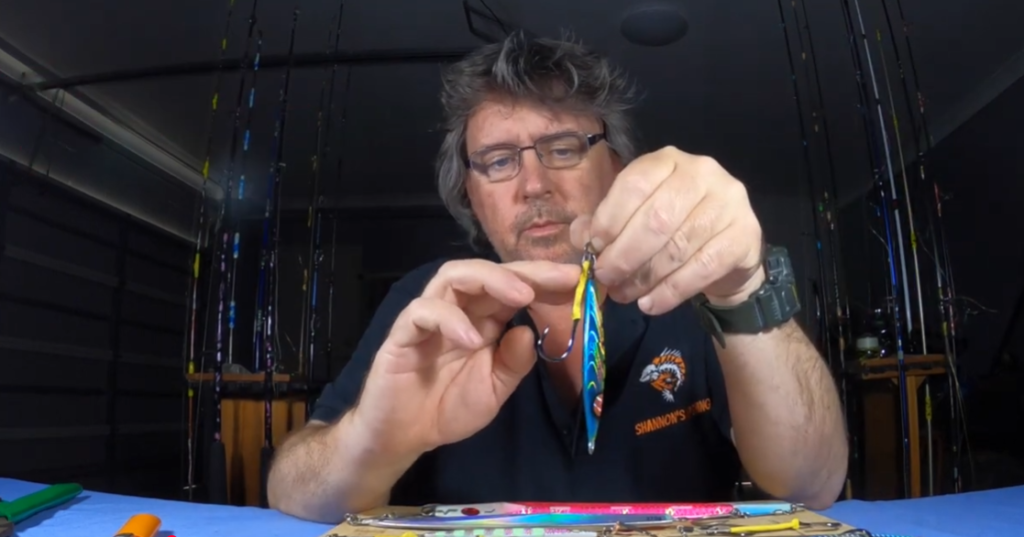
The final step is matching the finished hooks to the jig.
Hold the rig against the jig and check where the hooks sit. On a knife jig, longer hooks can work well. On a small flutter jig, you may want shorter hooks that sit closer to the head of the lure.
The beauty of DIY jig hooks is that you can adjust everything. You can make them longer, shorter, single, double, stiff, free-swinging, plain wire, heat shrink covered, or dressed up with flash.
There is no one perfect setup for every jig. The best setup is the one that matches the lure, the fish, and the way you are jigging.
Final Thoughts on DIY Jig Hooks
DIY jig hooks are cheap, strong, and easy to make. They are a great option for anyone who fishes micro jigs, flutter jigs, or knife jigs and wants a tougher hook setup.
Using 150 lb multi-strand wire makes them strong and helps stop bite-offs from toothy fish. The solid ring keeps the pressure in the right place. The wire helps reduce tangles. The heat shrink gives you a neat finish. And because you are making them yourself, you can build them exactly how you want.
If you fish around mackerel, jackets, kingfish, reef fish, or the odd wahoo, these heavy-duty DIY jig hooks are worth trying. Make a few different lengths, test them on different jigs, and see what works best for your fishing.
They are simple, strong, cheap, and once you start making them, you will probably wonder why you did not do it earlier.
More Fishing Guides & Resources
Want more practical fishing tips you can use straight away? Check out the latest Shannon’s Fishing PDF guides covering rigs, bait tricks, lure techniques, and proven methods for catching more fish around Australia.