
Skirted lure hook rigs are simple to make at home, yet many anglers still buy ready-made hook sets that do not properly match their lures. The hooks can be too big, too small, too long or too short, leaving them in the wrong position inside the skirt.
Making your own rigs fixes that problem, and custom skirted lure hook rigs are easy to reproduce once you know the correct measurements. You can match each hook set to the exact lure, choose the hook and wire strength you trust, and save money at the same time.
This setup is ideal for light-tackle trolling for dolphinfish, wahoo and small black marlin.
Below is the method I use to make single and two-hook skirted lure hook rigs with inline hooks, flexible wire, double crimps and heat shrink.
Why Make Your Own Skirted Lure Hook Rigs?
The main advantage of homemade skirted lure hook rigs is correct hook placement. Well-fitted skirted lure hook rigs also help the lure run cleanly without unnecessary hardware hanging behind the skirt.
A ready-made hook set might look close in the tackle shop, but the wire section can be too long or too short for your lure. That may leave the hook hanging well behind the skirt or sitting too far forward against the lure head.
When you make the rig yourself, you measure it directly against the lure before cutting the wire. This puts the hook close to the rear of the skirt, where it can work properly without upsetting the lure’s action.
It can also save money. One pre-made hook set may cost around $20 to $30. A packet of hooks, some wire, crimps and heat shrink can make several skirted lure hook rigs.
What You Need
You only need a few basic items:
- A skirted trolling lure
- Quality inline single hooks
- Flexible multistrand wire
- Double-barrel crimps matched to the wire
- A crimping tool
- Heat shrink tubing
- Side cutters
- A heat gun or hot water
For smaller lures on light tackle, I like flexible 150-pound multistrand wire.
It is strong, has a little movement and does not kink as easily as stiff wire. Match the wire strength to the lure, tackle and fish you are targeting.
Choose the Correct Hook for Skirted Lure Hook Rigs
Take the lure with you when buying hooks. A good starting point is to choose a hook with a gape roughly matching the width of the lure head.
The size does not need to be perfect down to the millimetre, but it should look balanced.
A hook that is too large can overpower a small lure. A hook that is too small may not have enough gape for a clean hookup.
Use an inline hook, not an offset hook.
When viewed from the front, the hook point and shank should sit in the same straight line. An offset hook can act like a small keel and may make the lure twist while trolling.
Do not worry if the hook looks large by itself. Once fitted inside a seven-inch skirt, it normally looks far more balanced.
Measure the Wire Against the Lure
Correct wire length is what makes custom skirted lure hook rigs fit properly.
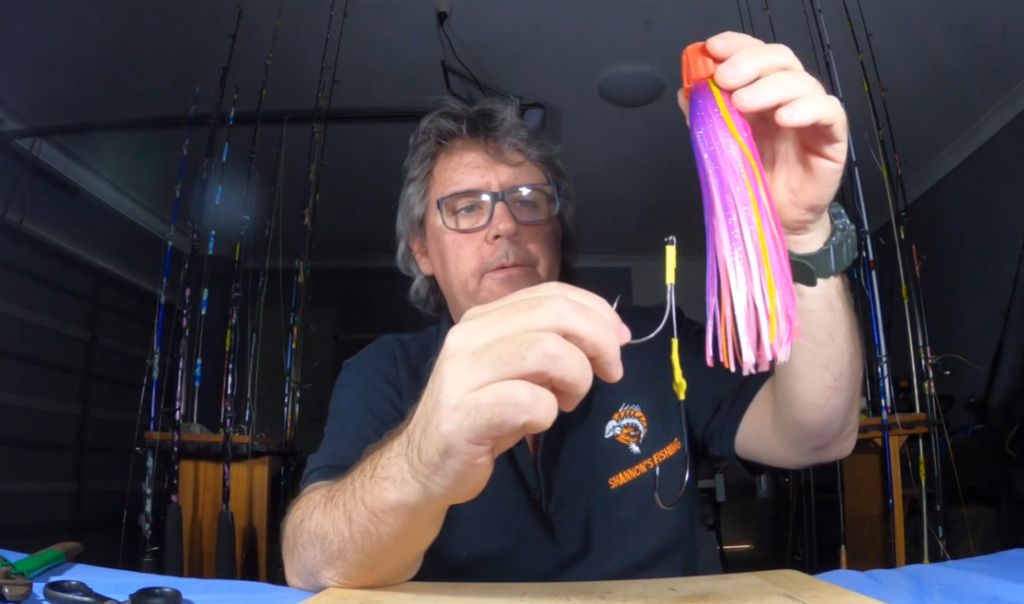
Slide the wire under the skirt until it reaches the back of the lure head. Straighten the skirt and run the wire towards the tail.
Mark the wire about one centimetre short of the end of the skirt, then cut it.
Once the hook, loops and crimps are added, the hook should sit close to the rear of the skirt without hanging too far behind it.
Measure every lure instead of assuming all skirts and heads are the same length.
You can see the equipment I recommend for different styles of fishing on my main Fishing Gear page.
Crimp the First Hook
Slide a double-barrel crimp onto one end of the wire. Pass the wire through the hook eye and back through the other side of the crimp.
Pull it through until there is a small loop around the hook eye. Do not pull the loop completely tight.
I like the hook to retain a little movement before the heat shrink is added.
Place the crimp correctly in the crimping tool and compress it firmly. Use a crimp that properly matches the wire diameter.
After crimping, pull hard on the hook and wire. Every one of your skirted lure hook rigs should be tested before it goes fishing.
Make the Leader Loop
Place another crimp on the opposite end of the wire. Feed the wire back through the crimp to create a loop, then crimp it firmly.
Do not make this loop too small.
It needs enough room for the leader connection and any protective tubing used around the leader crimp.
Keep the loop centred so the hook rig sits straight behind the lure head.
Add Heat Shrink to Stiffen the Rig
Cut a piece of heat shrink long enough to cover the hook eye, wire loop and crimp.
Slide it over the connection and shrink it carefully.
A heat gun or hot water gives better control than a lighter. An open flame can burn the tubing or damage nearby material if too much heat is applied.
The tubing stiffens the hook connection and helps keep the hook aligned. This is often called a stiff rig.
Allow the tubing to cool, then make sure the hook is straight and the crimp is fully covered.
How to Make Two-Hook Skirted Lure Hook Rigs
Adding the second hook is easier than it looks.
Cut another short piece of heat shrink and slide it over the eye of the second hook. Position that hook against the wire loop near the first hook.
Make sure both hooks face the same direction. I prefer them to be slightly offset from one another rather than sitting perfectly straight.
Move the heat shrink over the connection and apply heat until it grips firmly.
The finished two-hook skirted lure hook rigs should look neat, with the hooks facing the same way and sitting with a small offset.
Pull firmly on both hooks and check that the tubing has not split.
Single Hook Versus Two Hooks
A single-hook rig is simple, tidy and easy to maintain. It also puts less hardware inside the skirt.
A two-hook rig gives you another hook point farther back, which some anglers prefer when fish are striking short.
The best choice depends on the lure, target species, local fishing rules and any tournament or record requirements.
Before fishing, check the current Queensland recreational fishing equipment rules.
Check the Hook Position
Slide the completed rig into the lure and connect it as it would sit while trolling.
The hook should sit neatly near the back of the skirt. It should not be jammed against the lure head, and it should not swing a long way behind the skirt.
Turn the rig by hand and check that the hooks, wire and leader loop are aligned. If it pulls to one side, inspect the hook style, crimps and loops.
Correct alignment is important because even strong skirted lure hook rigs can make a lure swim badly when the hardware is crooked.
Properly aligned skirted lure hook rigs should sit straight and balanced behind the lure head.
Common Skirted Lure Hook Rig Mistakes
The first mistake is buying hooks without comparing them to the lure.
Take the lure to the tackle shop and match the hook gape to the head. This is more reliable than trying to remember the size or guessing from the packet.
The second mistake is using offset hooks. They can cause a trolling lure to twist instead of swimming cleanly.
Another common problem is cutting the wire too long. Measure from the back of the lure head to about one centimetre short of the skirt before cutting.
Do not use oversized crimps. Match the crimp to the wire and use the correct section of the crimping tool.
Poorly compressed crimps can slip, while crimps that are crushed too heavily can damage the wire.
Make sure both hooks face the same direction when building a two-hook setup. The hooks can be slightly offset, but they should not point in completely different directions.
Finally, never skip the pull test.
Test every connection before storing your skirted lure hook rigs in the lure roll. It is far better to find a weak crimp at home than when a marlin, wahoo or large dolphinfish strikes the lure.
Test the Lure Before Fishing
After making the rig, run the complete lure beside the boat at trolling speed.
Watch the lure closely and make sure it is swimming correctly. It should not spin constantly or pull heavily to one side.
If it twists, check that you are using an inline hook. Also inspect the leader loop, crimps and hook alignment.
A hook set that is too heavy can also affect a smaller lure. Match the hook and wire to the lure rather than using the heaviest equipment available.
Testing your skirted lure hook rigs before placing them in the trolling spread gives you a chance to correct any problems.
Store Your Hook Rigs Safely
Wash the hooks, wire and crimps with fresh water after use, particularly after fishing in salt water.
Allow the rigs to dry before storing them. Putting wet hooks straight into a lure roll can encourage rust and corrosion.
Inspect the heat shrink for cuts, splitting or movement. Check the wire for kinks and examine every crimp for signs of damage.
Touch up or replace hooks that have become blunt. Pelagic fish often have hard mouths, so sharp hooks are important.
A few minutes of maintenance can keep skirted lure hook rigs ready for the next trolling trip.
Final Thoughts
Making skirted lure hook rigs is quick, easy and cheaper once you have the materials at home.
More importantly, every rig can be matched to the exact lure instead of relying on a generic hook set.
Choose a strong inline hook, use flexible wire suited to your tackle, measure the wire against the skirt, crimp both ends carefully and cover the hook connection with heat shrink.
For two hooks, keep them facing the same direction with a slight offset.
After making a few skirted lure hook rigs, the whole process becomes very fast. You will have cleaner rigs, better hook positioning and more confidence when a dolphinfish, wahoo or marlin strikes.
More Fishing Guides & Resources
Want more practical fishing tips you can use straight away? Check out the latest Shannon’s Fishing PDF guides covering rigs, bait tricks, lure techniques, and proven methods for catching more fish around Australia.