
If you want to learn how to rig skirted lures, the good news is it is nowhere near as complicated as many people think. A lot of anglers look at skirted trolling lures, wire traces, crimps, hook placement, heat shrink, and leader tube and think it must be some big technical job.
It is not.
Once you understand the basic process, you can rig your own skirted lures at home and get the hook sitting in the right position nearly every time. That means a better swimming lure, a cleaner hook-up, and less wasted money when something with teeth comes through and smashes your gear.
In this guide, I’ll walk through a simple way to rig skirted lures using single and double hook rigs. This setup works well for offshore trolling and is useful when chasing species like marlin, wahoo, dolphin fish, tuna, mackerel, and other pelagics.
The method is simple. Measure the wire off the skirt, crimp the hook rig, use heat shrink to stiffen the hook, and then connect it to your leader with protective tube. Once you have done a couple, you will see how easy it really is.
Why Learning How to Rig Skirted Lures Matters
Rigging your own skirted lures gives you more control.
You can choose your hook size, wire strength, hook position, leader length, and whether you want a single hook or double hook setup. This is important because not every skirted lure swims the same, and not every pre-made hook rig suits the lure you are using.
The biggest thing is hook placement.
If the hook sits too far forward inside the skirt, you can miss bites. If it hangs too far back, the lure can look wrong, swim badly, or become messy around the boat. A good starting point is to have the bottom hook point sitting just outside the end of the skirt, or the single hook sitting nicely near the back of the skirt.
This is why measuring the hook rig from the lure itself is such a good trick. Instead of guessing, you use the skirt as the measuring guide.
What You Need to Rig Skirted Lures
You do not need a huge amount of gear to rig skirted lures properly.
You will need:
Multi-strand wire
Crimps to suit the wire
Mono or leader material
Protective tube
Heat shrink
Hooks
Crimping tool
Scissors or cutters
Skirted trolling lure
For smaller skirts, around 150 lb multi-strand wire is often enough. For larger blue marlin style lures, you may want to go heavier, depending on the size of the lure, the target fish, and the tackle you are using.
For leader, around 100 lb is a good practical starting point for many smaller skirted trolling lures. In the video, 130 lb leader was used because that was what was available, but around 100 lb would normally be the preferred choice for that style of smaller lure.
Always match your crimps to the wire and leader size. A bad crimp can cost you a good fish.
Also, if you are fishing in Queensland or other Australian waters, always check the current recreational fishing rules before keeping any fish. You can check the official Queensland recreational fishing rules here: Queensland recreational fishing rules.
Step 1 — Choose the Right Hook Setup
The first choice is whether you want to rig your skirted lure with a single hook or a double hook rig.
A double hook rig is often used in larger skirted lures. It gives you two hook points and can sit nicely through the skirt when rigged correctly. Some anglers like this setup because they feel it gives them better coverage on larger lures.
A single hook rig is simpler, cleaner, and safer.
For a lot of fishing, especially when fishing alone or with people who are not used to handling offshore fish, a single hook is a very good option. There is only one hook in the fish and no second hook swinging around near someone’s hand, wrist, or the side of the boat.
Single hooks can still hook fish very well, especially when they are sitting correctly near the back of the skirt.
You can see the equipment I recommend for different styles of fishing on my main Fishing Gear page.
Step 2 — Measure the Wire Against the Skirt
This is the trick that makes the whole job easier.
Lay the lure down on the bench. Take your multi-strand wire and push it up inside the skirt until it touches the back of the lure head. Then measure down to around one centimetre inside the bottom of the skirt.
That is where you cut the wire.
This gives you a hook rig that is matched to that lure instead of just guessing. Once the leader loop and protective tube are added, the hook will usually sit back in a good position.
This is one of the simplest ways to rig skirted lures with consistent hook length.
Step 3 — Crimp the First Loop
Once the wire is cut, slide on a crimp and make a small loop at one end.
Do not make the loop too tiny. You still need enough room for your leader and protective tube to pass through later.
Crimp it down firmly with the correct crimping tool. The crimp should be secure, neat, and matched to the wire size.
This loop will later connect to your leader.
Step 4 — Crimp the Hook Onto the Other End
Now take the other end of the wire and pass it through the eye of the hook.
Be gentle with the wire. Do not kink it or damage it. Pull it down into a nice small loop so the hook is connected cleanly.
Then crimp it.
At this stage, the hook may still be free swinging. That is fine because the heat shrink will help stiffen the hook later.
A stiff hook rig can help keep the hook sitting in the right position and may improve hook-up consistency.
Step 5 — Use Heat Shrink to Stiffen the Hook
Heat shrink is one of the easiest ways to tidy up and stiffen the hook rig.
Cut a short piece of heat shrink long enough to cover the crimp and go slightly down the hook shank. Slide it over the hook and wire, then shrink it down.
A heat gun is best. Hot water from a kettle can also work well. A lighter can work in a pinch, but it can blacken or burn the heat shrink if you are not careful.
For a double hook rig, the second hook can be held in place with heat shrink as well. Slide the heat shrink over the second hook, tuck the wire loop under it, line the hook eye up with the wire, and shrink it down. That gives you a simple double hook rig without needing to crimp the second hook separately.
Once finished, you can twist the wire slightly to offset the hooks how you like them.
Step 6 — Connect the Hook Rig to the Leader
Now thread your leader through the centre of the skirted lure.
At one end of the leader, make a loop using a crimp and protective tube. The protective tube helps stop the leader from rubbing or cutting during a long fight.
On the hook end, slide on your crimp and protective tube, then pass the leader through the wire loop and hook eye if needed. Pull everything down neatly before crimping.
Before you crimp the final connection, pull the hook rig up into the skirt and check the hook position.
This is important.
Make sure the hook is not too far inside the skirt and not hanging too far out the back. For a double hook rig, the bottom hook point sitting just outside the bottom of the skirt is a good position. The top hook can sit around halfway up the skirt.
For a single hook rig, aim to have the hook sitting nicely at the back of the skirt.
Step 7 — Fix Hook Position Problems Before You Fish
Sometimes pre-made hook rigs are too short or too long.
If the hook is sitting too far forward inside the skirt, you can add a small bead or two between the lure head and the hook rig to push the hook farther back. Lumo beads can work well for this.
Do not go silly with beads. If you need a heap of beads to make the hook sit right, the hook rig is probably the wrong length and should be remade.
If the hook sits too far back, shorten the rig or make a new one.
Getting the hook position right is one of the most important parts of rigging skirted lures.
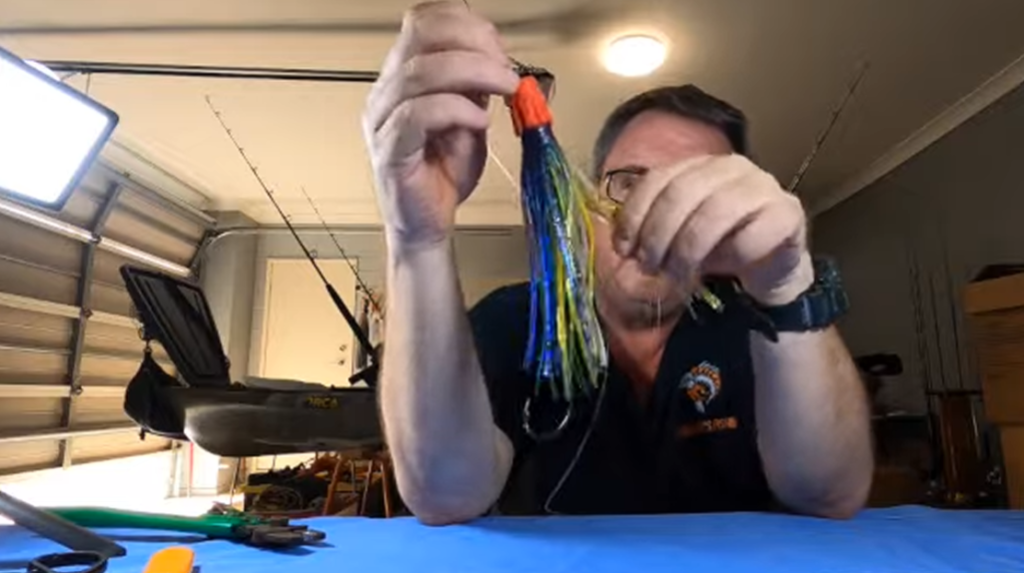
Single Hook vs Double Hook Skirted Lure Rigs
Both single and double hook rigs work.
A double hook rig can be useful on bigger skirts and gives you two points. Some anglers like them for larger trolling lures and bigger offshore targets.
A single hook rig is cleaner and safer. It is often the better choice when fishing alone, when releasing fish, or when fishing with people who may not be experienced with handling fish beside the boat.
One hook in the fish is better than one hook in the fish and another hook swinging around near someone’s hand.
Single hooks can also be cheaper to replace, which matters because quality hooks are not cheap. If a wahoo or mackerel damages your skirt or wire, losing one hook hurts less than losing a full double hook rig.
Why Use Wire in Skirted Lures?
Some anglers do not like using wire in skirted lures.
If you are only chasing tuna or fish without sharp teeth, you may not need wire. But in warmer water, especially around South East Queensland, New South Wales, and other areas where wahoo and mackerel are around, wire can save your lure and your fish.
Wahoo and mackerel can slice skirts apart with razor sharp teeth. If they hit your lure and cut everything off, you do not want to lose your hook as well.
A short piece of wire does not seem to worry many pelagics. Dolphin fish, tuna, and marlin will still eat a properly rigged skirted lure.
Final Skirted Lure Rigging Tips
Do not overcomplicate the job.
Use soft multi-strand wire, crimps that fit properly, protective tube, and heat shrink. Measure the wire using the lure itself. Check the hook placement before the final crimp. Keep your crimps neat and do not damage your leader.
When crimping mono, avoid crimping right on the ends of the crimp because it can create a sharp edge that may damage the leader. Leave the ends slightly flared where possible.
With wire, it is a bit more forgiving, but clean crimping is still important.
Once you have rigged a few skirted lures yourself, it becomes quick and easy. Better still, there is a good feeling when you go out and catch fish on gear you rigged yourself.
Conclusion
Learning how to rig skirted lures is a simple skill that can save money, improve hook placement, and give you more confidence when trolling offshore.
The main things are easy to remember.
Measure the wire against the skirt. Use the right crimps. Use heat shrink to stiffen the hook rig. Protect your leader loops with tube. Check your hook position before the final crimp.
Whether you prefer single hooks or double hooks, the goal is the same: a clean, strong, reliable skirted lure rig that swims properly and hooks fish when they bite.
Once you get the hang of it, you will wonder why you ever thought it was hard.
More Fishing Guides & Resources
Want more practical fishing tips you can use straight away? Check out the latest Shannon’s Fishing PDF guides covering rigs, bait tricks, lure techniques, and proven methods for catching more fish around Australia.