
Whether you are a seasoned offshore angler or just getting started with toothy pelagics, mastering Spanish mackerel rigging tips is the difference between a shredded bait and a trophy fish on the deck. Last week, I shared some techniques for Mackerel 101, and the feedback was incredible. While there is no single “correct” way to rig a Wog-head, several experts reached out to discuss the “proper” way using rigging wire.
Today, we are diving deep into that specific method. We are going to build a heavy-duty rig designed for the 40kg monsters we see up in Cairns during the peak season around October. If you have ever looked at a Wog-head and wondered, “How on earth do I rig this?”—this guide is for you.
1. Choosing the Right Components for Spanish Mackerel Rigging Tips
To target big Spanish Mackerel, you need hardware that won’t fail under pressure. Since I’m fishing in North Queensland, I prefer an 88 lb single-strand wire. If you are further south targeting 10–15kg fish, you can get away with 40–60 lb wire, but for the big boys, heavy wire is a must.
You will also need:
- Wog-Head: A specialized trolling head with feathers.
- Mustad 7766 Hooks: I use size 6/0.
- Black Crane Swivel: To prevent line twist.
- Rigging Wire: This is thin, soft copper wire used to secure the bait’s nose.
See my Mackerel Fishing Gear page for the tackle and lures I recommend for casting and trolling.
2. Building the Foundation: The Haywire Twist
Start by taking about a foot and a half of your 80 lb wire. We want a relatively short bite trace. On one end, attach your crane swivel using a Haywire Twist.
Because this heavy wire is tough on the hands, use a pair of pliers to hold the loop while you make your wraps. Remember to “break” the tag end off by bending it back and forth rather than cutting it; this leaves a smooth finish that won’t cut your fingers later. For more information on wire grades and terminal tackle, check out Mustad’s fishing guides for technical specs.
3. Ganging the Hooks for Maximum Hookup Rates
For this specific rig, we are using a four-hook “gang” setup. Because we are baiting with garfish, four hooks provide better coverage than three.
- Take three of your Mustad 7766s and use side cutters or pliers to slightly open the eyes.
- Join them together so they sit in a line.
- The Secret Trick: On the fourth (bottom) hook, rig it upside down (facing the opposite way).
Mackerel are notorious for “short-striking” or clipping the tails off baits. By having that last hook free-swinging and facing the opposite direction, you catch those tail-snippers that would otherwise miss the hooks entirely.
4. Integrating the W-Head and Rigging Wire
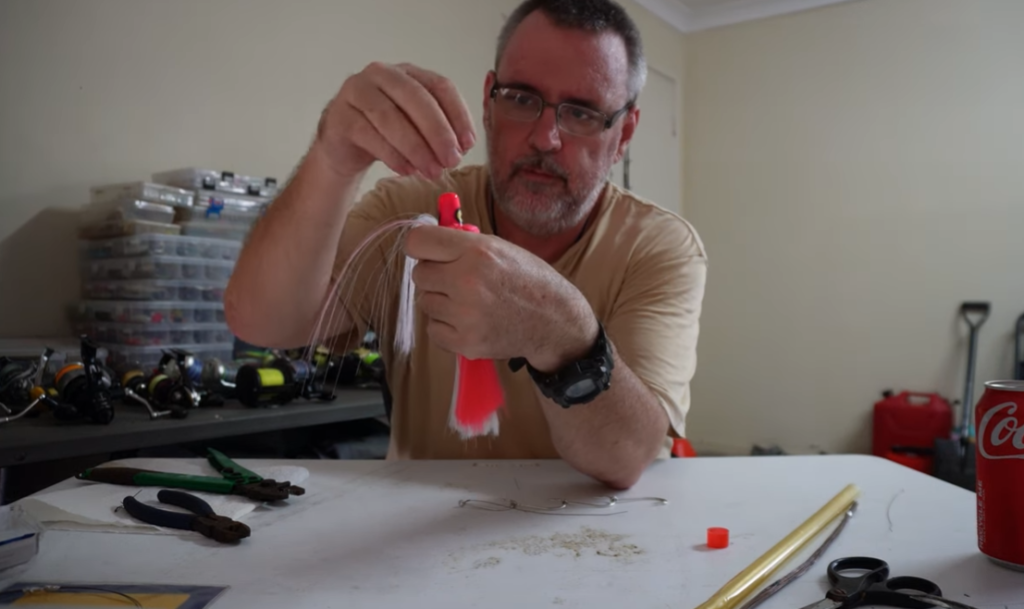
Before finishing the wire twists to your hooks, slide your Wog-head onto the main wire. Ensure it is facing the right way: the “pointy” end with the eyes should face the swivel, as it will be pulled through the water from that end.
Next, attach your rigging wire to the eye of the top hook. I like to use a rough Haywire Twist to secure the copper wire. This wire is the most important part of these Spanish Mackerel rigging tips because it ensures the bait stays locked into the Wog-head cavity during high-speed trolls.
5. Preparing the Garfish Bait
A dead bait only works if it looks alive in the water. Grab a fresh garfish and follow these steps:
- Snap the beak: You don’t need the long spear.
- Loosen the spine: Run your thumb along the lateral line to “crack” the scales and loosen the meat. This makes the bait swim with a natural “S” action.
- Empty the gut: Gently squeeze the belly to remove any waste. This prevents the bait from bloating or rotting quickly in the sun.
6. Final Assembly: Pinning the Bait
Insert your hooks into the garfish, starting from the tail and working up. Your first hook eye should sit directly level with the garfish’s eye.
Take your copper rigging wire, poke it through the garfish’s eye sockets, and wrap it tightly around the hook shank and the nose of the fish. This “pins” the fish’s head so it can’t slide down the hooks. Finally, jam the nose of the garfish into the hollow cavity of the Wog-head.
7. Trolling for Success
When you drop this rig over the side, the feathers will fold back over the garfish, and the tail will kick beautifully. You aren’t looking for high-speed trolling here; 1 to 3 knots is the “sweet spot” for dead baits. With the upside-down trailer hook, you are ready for those aggressive strikes.
Follow these Spanish Mackerel rigging tips, and you’ll find that the Wog-head is one of the most effective tools in your tackle box for landing massive mackerel.
More Aussie Fishing Guides & Resources
Looking for more practical fishing tips? I’ve put together a growing collection of Shannons Fishing resources, including downloadable PDF guides, cheat sheets, rigs, bait tips, and step-by-step fishing advice made for Aussie fishos.