
Do night fishing lures actually work once the sun goes down? The simple answer is yes, they absolutely can. The mistake a lot of anglers make is thinking every lure works the same at night as it does during the day.
At night, fish rely more on vibration, noise, smell, silhouette and water movement. That means some lures become even better after dark, while others can be harder work unless you are fishing around lights, bridges, bait schools or structure.
This guide breaks down the main night fishing lures I would use for inshore, offshore, rivers, beaches, bridges and reef fishing.
Do Night Fishing Lures Really Work?
Yes, night fishing lures work, but you need to match the lure to the area and the fish you are chasing.
If you are fishing in complete darkness, lures with vibration, rattle, water push or a strong action will usually be easier for fish to find. If you are fishing under bridge lights, marina lights, jetties, pontoons or lit-up walkways, smaller lures can work very well because baitfish often gather there.
That is why a lure that feels useless in pitch-black water might suddenly become deadly under lights where bait is holding.
Casting Slugs At Night
Casting slugs are great during the day, especially when fish are feeding on small bait, but they are not usually my first pick for night fishing.
Small metal slugs do not push much water and do not give off much vibration. In open darkness, they can be hard for fish to find. But around bridge lights, wharves or lit-up areas where baitfish are packed in, small slugs can still work.
If I was going to use casting slugs at night, I would fish them around lights for species like trevally, queenfish or tailor rather than throwing them out into pitch-black open water.
Vibes Are Great Night Fishing Lures
Vibes are one of the better night fishing lures because they send out a strong vibration. That vibration helps fish find them even when visibility is poor.
They are a good option for deeper channels, bridge pylons, river mouths, port areas and lit-up water where bait is moving through. Barra, jacks, threadfin salmon, jewfish and trevally can all respond well to vibes at night.
The big advantage with vibes is that you do not need the fish to see the lure perfectly. The lure’s vibration does a lot of the work.
Poppers And Surface Lures At Night
Poppers, stick baits and small surface lures can be excellent at night, especially in rivers, canals, beaches, gutters and around bait schools.
These are strong night fishing lures because they make noise and push water. Fish can hear and feel them from a distance. Trevally, tailor, queenfish, jacks and even bigger reef species can smash surface lures after dark.
Small poppers can be great fun around canal lights and bridges. Bigger poppers and stick baits can work along beaches and river mouths when tailor or trevally are hunting.
This is one style of lure I would not be scared to use in full darkness.
Visit Fishing Lures That Do the Job for the hard-bodied, surface and squid-style lures I recommend for particular situations.
Small Divers At Night
Small hard-body divers can catch fish at night, but they are usually better around structure and light.
If you are trolling or casting small divers across open flats in complete darkness, it can be tough going. You might still get the odd flathead, school jew or jack, but it is not usually the easiest method.
Where small divers shine is around bridges, pontoons, rock walls, mangrove edges and lit-up canals. If there is bait holding there, little divers can work well.
For night fishing, I would use divers close to structure rather than randomly casting them into empty water.
Soft Plastics At Night
Soft plastics are some of the most useful night fishing lures, but size and location matter.
Small light plastics can work well around bridge lights, lit-up banks, pontoons and bait schools. They are good for flathead, trevally, jacks and smaller jewfish when the fish are feeding around lights.
In complete darkness, I would usually go bigger. Bigger paddle tails, curl tails and larger soft plastics put out more action and give fish more vibration to track. These are a better choice for jewfish, barra, jacks and reef species in deeper water.
If you are chasing jewfish in deep channels or river mouths at night, bigger soft plastics are definitely worth using.
Big Soft Plastics For Barra And Jewfish
Big plastics are some of the best night fishing lures for barra and jewfish.
Barra feed well at night in rivers, dams and estuaries, and a larger soft plastic with strong tail action can be deadly. Jewfish are also a great target after dark, especially in deeper channels, river mouths and offshore reef edges.
The key is to use a lure that moves enough water for the fish to feel it. Big paddle tails, larger curl tails and heavier plastics all give you a better chance when there is not much light.
Jerk Baits At Night
A few years ago, I would have said jerk baits were mostly a daytime lure or something to use around lights. But plenty of anglers are now catching jewfish in shallow water at night using jerk baits.
They can also be excellent for barra, especially around moonlit nights, shallow edges, timber, weed beds and structure.
Jerk baits are worth trying around flats, shallow channels, bridges and river edges. They are not always the easiest lure to fish at night, but they can definitely work when the fish are hunting shallow.
Offshore Stick Baits At Night
Big offshore stick baits are proven during the day for tuna, mackerel, trevally and reef fish. At night, they can still work, but the hard part is finding the fish.
If you are on a reef edge, shallow bommie or area where GTs, trevally or reef predators are feeding, stick baits can get smashed after dark. But out in open blue water, locating the fish is the biggest challenge.
For reef fishing at night, big surface lures are worth a crack. For open-water tuna schools, night fishing is a lot harder because you often cannot see the birds, bust-ups or surface activity.
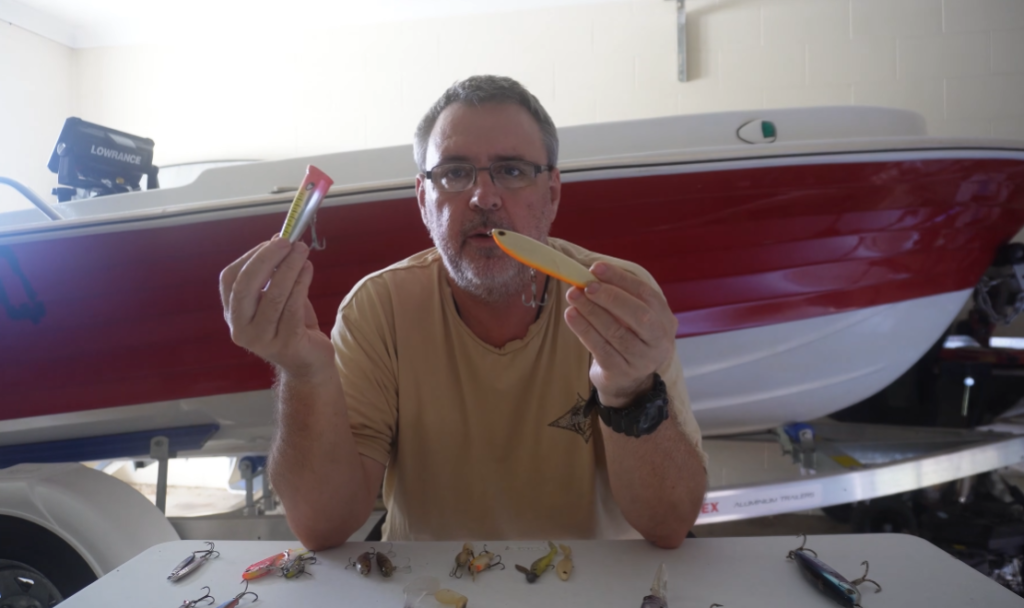
Slow Pitch Jigs And Micro Jigs At Night
Slow pitch jigs and micro jigs are underrated night fishing lures.
A lot of anglers do not use them enough after dark, but they can catch snapper, jewfish, nannygai, red emperor and other reef species. Lumo jigs are especially useful. Charge them under a torch or boat light, then send them down.
The glow, flutter and slow movement can work very well when fish are feeding near the bottom.
If you are fishing offshore at night, do not leave the jigs in the tackle box.
Knife Jigs At Night
Big knife jigs and high-speed jigs are still a bit of a question mark for me at night.
They work during the day on kingfish, amberjack, dogtooth tuna and other hard-fighting species, but not as many anglers talk about using them in darkness. They may work, but it depends on the fish, the depth and whether the fish are actively feeding.
This is one area where more testing is needed.
Skirted Lures At Night
Skirted lures can work at night, especially for big tuna and swordfish-style fishing.
Some offshore anglers troll skirts at night with glow sticks, light sticks or scented bait cages added to the lure. The idea is simple: give the fish light, movement and smell.
One warning though: trolling for marlin at night can be dangerous because you cannot always see where the fish is jumping or what it is doing near the boat. Use common sense and fish safely.
For tuna and other offshore predators, skirted lures with scent and light can be very effective after dark.
Best Places To Use Night Fishing Lures
The best places to use night fishing lures are areas where fish can easily find food.
Good night spots include bridges, river mouths, canal lights, pontoons, rock walls, beach gutters, reef edges, deep channels, bait schools and areas with current.
Lights are a huge advantage because bait gathers around them. But even in complete darkness, lures with vibration, rattle, glow, scent or strong water movement can still get eaten.
Before fishing any new area, always check your local size, possession and zoning rules. For Queensland anglers, the official recreational fishing rules are available on the Queensland Government fishing rules page.
Final Thoughts On Night Fishing Lures
Do not pack up just because the sun is going down. Plenty of fish still feed after dark, and the right night fishing lures can catch everything from flathead and trevally to barra, jewfish, snapper, reef fish and tuna.
The big thing is choosing the right lure for the job.
Use vibes, bigger plastics, poppers, stick baits and jigs when you need vibration and movement. Use smaller slugs, divers and plastics around lights where fish can see them better. Use lumo, scent and noise when fishing deeper or darker water.
Night fishing is all about experimenting. Try different lures, fish around bait, work the current and do not be scared to test something new.
You will never know what works until you put it in the water.
More Fishing Guides & Resources
Want more practical fishing tips you can use straight away? Check out the latest Shannon’s Fishing PDF guides covering rigs, bait tricks, lure techniques, and proven methods for catching more fish around Australia.