
It is that time of year again that every Gold Coast angler loves. December is just around the corner, which means the mackerel are starting to show up in numbers. I have already heard reports of Spotted Mackerel appearing off Palm Beach and even a handful inside the Seaway. While the last couple of seasons haven’t been anything flash, we are all hoping for a cracking season this year.
To help you get ready, I’ve put together a comprehensive guide on the best Mackerel Fishing Rigs and Lures that I use to target these fish. Whether you are bait fishing, trolling downriggers, or casting metal slugs, these “old school” methods will help you put more fish on the deck.
Understanding Spotted Mackerel Fishing Rigs and Lures
Spotties are usually the first to arrive on the local reefs like Mermaid and Palm Beach. Most people start by dropping an anchor and setting out a heavy burly trail to bring the fish to the boat. The standard method is floatlining using half a pilchard.
The most common Mackerel Fishing Rigs and Lures for this involve a short piece of 27lb wire with a small swivel and a hook crimped on. You simply let the bait waft down naturally through your burly trail. It’s a waiting game, but when the school moves through, you’ll see boats hooking up all around you.
See my Mackerel Fishing Gear page for the tackle and lures I recommend for casting and trolling.
The On-The-Fly Wire Rig Method
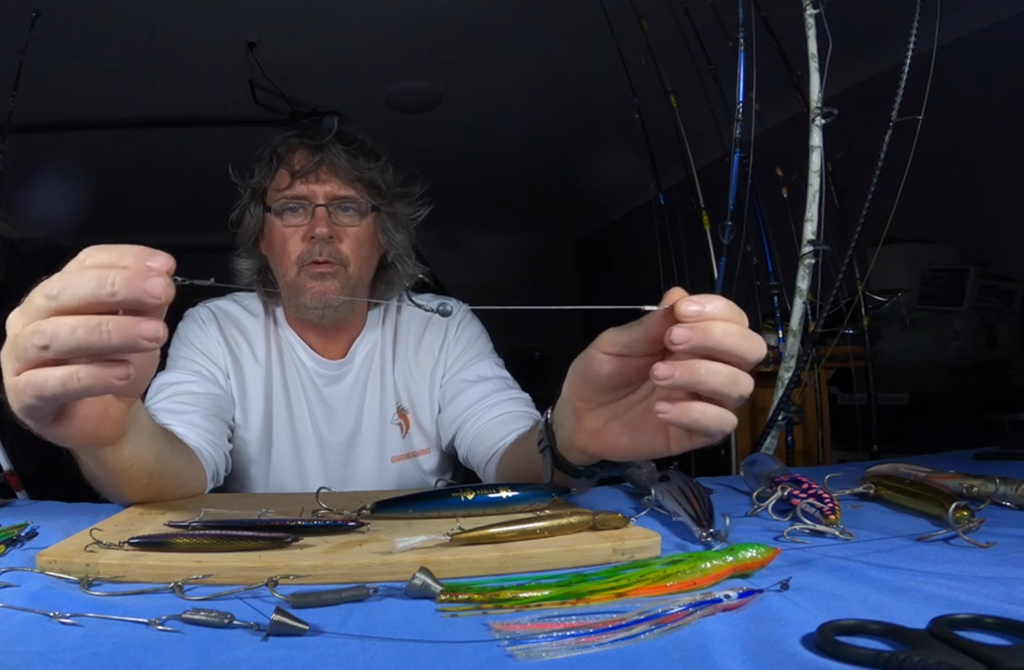
If you don’t want to carry crimps and pliers out on the boat, you can use a softer, nylon-coated wire (20lb to 30lb). This wire is fantastic because it is actually tieable. You can tie a Snell knot directly onto a 4/0 hook, which provides a very clean presentation.
To connect this to your main line, use an Albright knot to join the wire to a 15lb or 20lb fluorocarbon leader. This rig is quick to make while you are on the fly and works exceptionally well with half-pilchards floating through the water column. It is one of my favorite Mackerel Fishing Rigs and Lures because of its simplicity.
Casting Slugs and Matching the Hatch
When the mackerel are feeding on the surface, casting metal slugs is the most exciting way to catch them. The key is to “match the hatch.” Most of the spotties inshore are feeding on tiny baitfish like whitebait, so you should use small 20g to 30g slugs.
I prefer using black and silver patterns or resin-coated slugs that mimic the transparent look of whitebait. Instead of just winding them fast across the surface, try letting them sink down deep and then winding them back up through the entire water column. This often triggers a strike from fish that are holding lower than the surface schools.
Trolling Hard Body Mackerel Fishing Rigs and Lures
Trolling is a highly effective way to find fish when they are scattered. While many people use large lures, I’ve found that small hard bodies like the “Double Clutch” work wonders on spotties. They have a sharp shimmy and can be trolled at 5 to 6 knots.
For Spanish Mackerel, you want to look at bigger divers. Over the last few years, the Samaki Pacemaker has been a standout lure on the Gold Coast. Deep divers like the Nomad or the classic Halco Laser Pro are also essentials. I recommend running a mix of depths—put a deep diver out on one side and a shallow-running Rapala CD on the other to cover different parts of the water column.
Tactical Use of Downriggers
When the sun gets high and the fish move deep, a downrigger is the best tool in your kit. I use a downrigger loaded with multi-colored 90lb braid. Since the color changes every 10 meters, I know exactly what depth I’m at without needing a counter.
One “old school” tip is to use a bright protection tube on the end of your braid. This protects the line if the ball hits the bottom, but it also acts as a visual marker so you don’t accidentally smash the ball into the back of your boat when winding it up. Despite what some think, the bright colors don’t seem to scare the mackerel at all.
Selecting the Right Gear for Success
You don’t need heavy overhead gear to catch mackerel. For casting slugs, a 7-foot rod with a soft tip and a 4000-size reel is perfect. I run thin 20lb braid so I can cast a mile but still have enough “brakes” to stop a fish if I’m in a big crowd at Palm Beach Reef.
For trolling, an old-school Speedmaster or a TLD15 is more than enough. Some guys use TLD30s or 50s, but that is total overkill for mackerel. A 10kg mono setup will knock over almost anything you hook out here. Always make sure you check the latest Queensland Fisheries rules for size and bag limits before you head out.
Final Thoughts on Mackerel Fishing Rigs and Lures
The season is just starting to wind up, and the fish will only get thicker as we move toward Christmas. Remember to try different methods if the usual ones aren’t working—switch to a slow-pitch jig or try a twitch bait like a Rip Stop around the shark nets. Using the right Mackerel Fishing Rigs and Lures will ensure you have a successful and fun season out on the water.
More Aussie Fishing Guides & Resources
Looking for more practical fishing tips? I’ve put together a growing collection of Shannons Fishing resources, including downloadable PDF guides, cheat sheets, rigs, bait tips, and step-by-step fishing advice made for Aussie fishos.