
If you’ve been frustrated by the heavy boat traffic and dangerous swells of the Gold Coast Seaway, there is a safer, quieter alternative that holds absolute monsters. While many anglers head offshore to find their trophies, catching large Mulloway inside the Gold Coast Broadwater—specifically at the North Wall of Wave Break Island—is a specialized game that rewards the stealthy.
This isn’t about high-speed action; it’s about freezing your tail off in the middle of the night, being silent, and waiting for that one massive 15kg to 20kg fish to find your bait. In this guide, I’m breaking down the gear, the timing, and the “three-rod strategy” you need to master for success.
1. Timing the Sea-Running Mullet
The absolute “golden window” for catching large Mulloway at Wave Break is during July and August. This coincides with the sea-running mullet entering our systems. When you hear reports of mullet schools on the beaches or see them stacked up along the rock walls, that is your signal to go.
These big Mulloway (Jewfish) follow the food. They aren’t looking for tiny prawns; they are looking for a substantial meal. If the mullet are in the Seaway, they are almost certainly patrolling the deep hole off the North Wall of Wave Break.
2. Location: The Wave Break Deep Hole
Most locals know about the deep hole off the end of the Wave Break North Wall, near the yellow special marker. However, few know how to fish it correctly. There is a significant drop-off here where an eddy forms during the last two hours of the incoming tide.
When catching large Mulloway, you want to position your boat or kayak on the edge of that eddy. You want to be in the “dead” water where you aren’t fighting the current, allowing your baits to sit naturally on the edge of the deeper channel where the fish are hunting.
3. The Stealth Factor: Silence is Mandatory
This is where most people fail. In the shallow, quiet waters of the Broadwater, noise is your biggest enemy. If you are banging sinkers on the floor of a tinny or talking loudly, you will spook the big fish.
To be successful at catching large Mulloway, you need to fish between 1:00 AM and 4:00 AM. This is when boat traffic is at its lowest and the environment is dead quiet. A light westerly wind and a miserable, drizzly night are actually your best friends—it keeps the “fair-weather” fishos at home and keeps the fish confident.
4. The Bottom Bait: Running Sinker Rig
My first rod in the water is always a heavy bait on the bottom. Use a 15kg (30lb) overhead outfit with a 60lb “Tough Trace” leader.
- The Rig: A simple running ball sinker down to a swivel, with two snelled 7/0 or 8/0 hooks.
- The Technique: Drop a live mullet to the bottom, wind it up exactly one meter, and put the rod in the holder with the ratchet on and a light drag.
For the rods, reels, leader and terminal tackle I recommend, visit my Mulloway Fishing Gear page.
5. The Surface Bait: The Unweighted Mullet
While it sounds strange for Jewfish, catching large Mulloway often happens right at the surface. Since they are chasing mullet that are schooled up near the rocks, the predators are often looking up.
Take a second 30lb spin outfit with no sinker or beads—just two snelled hooks on a 60lb leader. Cast a live mullet out into the eddy and let him swim freely near the surface. This unweighted presentation is incredibly natural and often results in the most aggressive strikes of the night.
A healthy mullet that can swim naturally is far more effective than a weak or badly handled bait. For help choosing, caring for and presenting your bait, see my complete live bait fishing guide.
6. The Lure Strategy: Slow-Rolling the Rocks
While your live baits are working, you should be active with a third rod. I prefer a 30lb spin outfit casting large, dull-colored lures.
- The Lure: Use a big, shallow-diving hardbody (1 meter or less) or a 7-inch paddle tail.
- The Retrieve: Cast hard up against the rocks of the North Wall and use a very slow roll. You want the lure to act like a lazy mullet drifting with the current. This is a high-risk, high-reward move—big Jews hunt right against the stones, and they will “dust” you in a heartbeat if you aren’t ready to put the hurt on them.
Weather Safety: Check Weather Conditions (BOM) — Important for the “miserable night” stealth sessions.
Navigation: Gold Coast Seaway Navigation & Safety — Helps stay safe in the high-traffic Broadwater zones.
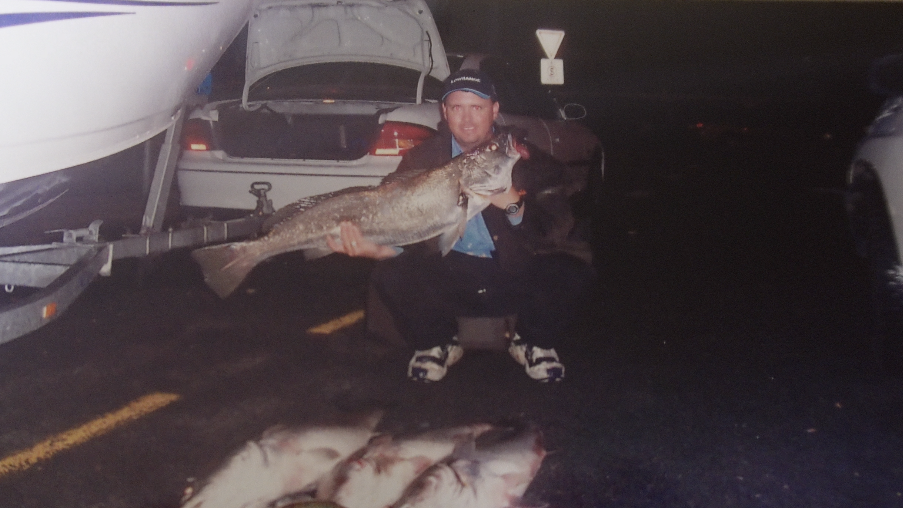
7. Identifying the Take: Jewfish vs. Sharks
One of the most important lessons in catching large Mulloway is knowing what you’ve hooked. Mulloway are lazy; they will almost always run with the current. If you hook a fish and it screams off against the tide toward the Seaway, it’s likely a shark or a ray. If the fish stays deep and uses its weight to move with the flow, get ready—you’ve likely found that 30lb trophy you’ve been hunting for.
More Fishing Guides & Resources
Want more practical fishing tips you can use straight away? Check out the latest Shannon’s Fishing PDF guides covering rigs, bait tricks, lure techniques, and proven methods for catching more fish around Australia.
More Mulloway Fishing Guides
Read the full mulloway fishing guide
How to Catch Big Mulloway in Reefs: 9 Proven Stealth Secrets